Exhibitions Temporary Exhibitions
Pericles and Dico Byzantios | Painting Affinities and Contrasts
-
03.04.25 - 21.09.25
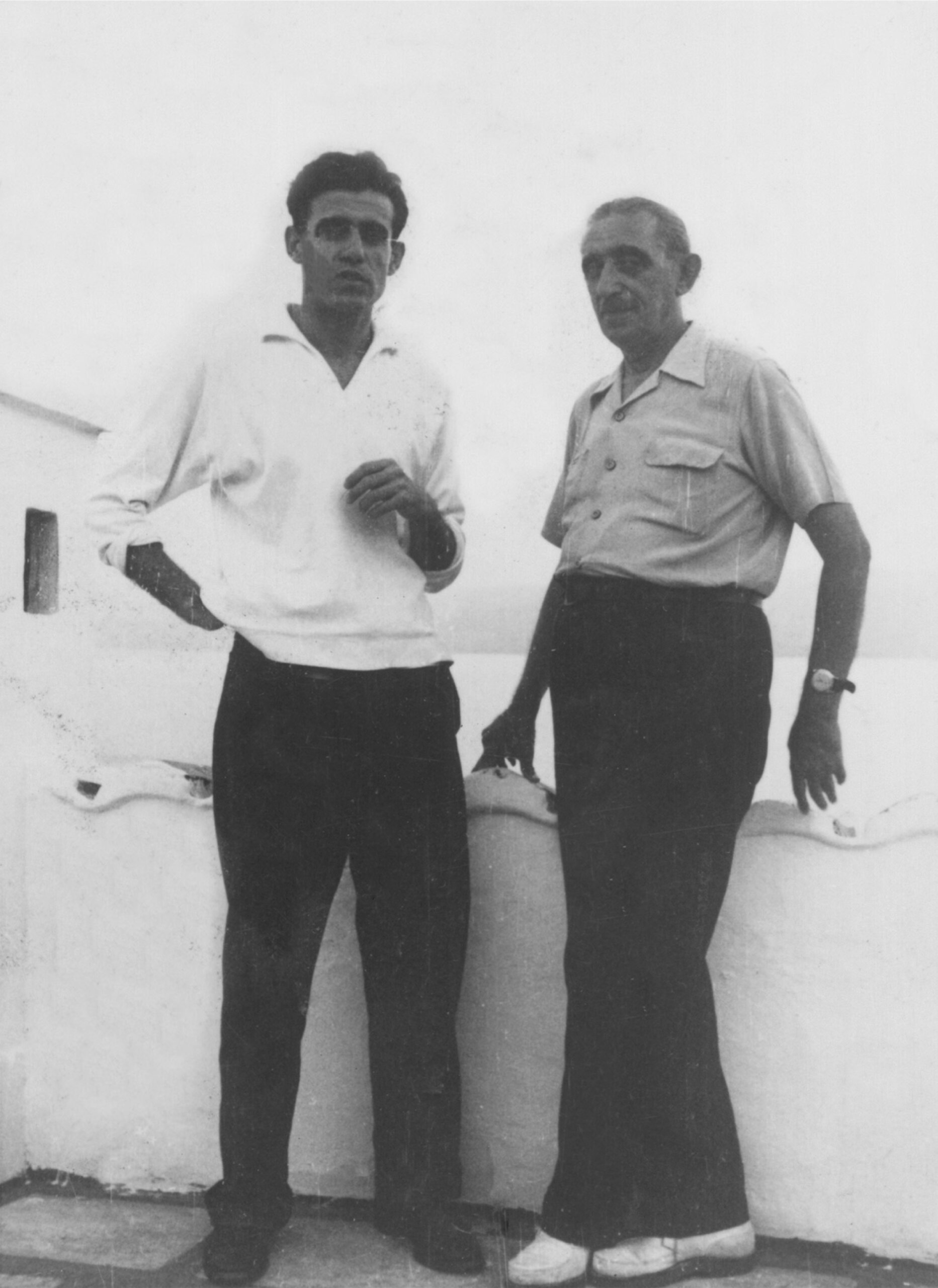
Pericles and Dico Byzantios
Painting Affinities and Contrasts
April 3 – September 21, 2025
The works of the renowned painters Pericles and Dico Byzantios—father and son—are being presented together for the first time at the B. & M. Theocharakis Foundation, showcasing key works from their artistic journeys. A large number of the works are from the collection of Alexandros Liakopoulos. They are complemented by loans from the collections of Antonis Komninos, EMST, Nikos Papageorgiou, Kyriakos Tsiflakos, and Christos Larsinos.
According to the Foundation’s Artistic Director and the exhibition’s curator, Takis Mavrotas:
“It is a challenging endeavor to comprehend the influence their relationship had on each other, their aesthetic similarities and differences, as they are defined by their shared themes and formal qualities, their distinguishing characteristics and influences, and the presence of differing artistic movements and rhythms. The contrast between these two painting worlds reveals their distinct personalities, as both strove throughout their lives to explore the indeterminate and mysterious realm of creation. We are also given the opportunity to look through the work of Pericles Byzantios at the inspired and studied work of Dico Byzantios and to recognize their direct connection with modern European art, particularly that of France.
Both aimed for their art to express a new morphological perspective—an image of Greece within Europe, with deep roots that touch the essence of the present, ‘with equality and equal sharing.’ (…)”
The exhibition offers a comprehensive introduction to the creative journeys of two significant painters, characterized by intuitive thinking and a definitive aesthetic viewpoint. Their works transcend the disintegration of our world, producing images crystallized through the soul and the secret depths of the spirit. Their unique character—responsibility, sensitivity, enthusiasm—and their cultivated aesthetic led to an ideal completeness in personal expression, through endless creative action and deep emotional perception. The clarity of their work reveals the breadth of a multifaceted painting style, distinguished by lucidity and grace, profound reflection, and insight, confidently claiming its place in the future.”
The painter Alexis Veroukas notes about Dico Byzantios’ work:
“To listen to Dico speak was like attending a seminar at the Hautes Études. Behind his words, you could hear the echoes of phrases he had heard himself from Sartre, but especially from Giacometti, perhaps the most important friend of his life. As he spoke, his long fingers would draw lines, circles, planes—as if composing one of his ‘cosmic still lifes’ in the air. Inevitably, our conversations referenced the ‘modern ark’ of Merlier and Milliex, known as the Mataroa (…).
You felt that your ‘interlocutor’ was an inseparable part of the very body of art and intellect. A tightrope walker of conception and analytical thought, but also of passion and Dionysian frenzy. He lived his life as a creator in Paris on such a tightrope. The first door that opened for him was that of the workshop of Dimitris Galanis, a friend of Pericles, and thus his name began to function as a ‘pass’ into the artistic world of Paris. His work soon became part of the dynamic movement of gestural abstraction in Paris, and his impressive talent secured him exhibitions in the leading galleries of the time.”
Museologist Iphigenia Botzaki writes in the accompanying exhibition catalog:
“Let us imagine two artists conversing through their works within a museum space. Such a ‘meeting’ is not just visual, but a dynamic experience that invites the visitor to participate in the dialogue. Every exhibition, every artwork encountered is a new world revealing itself. These moments of discovery—these ‘meetings’ with art—are turning points that activate internal mechanisms and help us better understand ourselves and the world around us. (…)
This exhibition is more than an opportunity to observe the evolution of two artists. It is the coexistence of father and son—an occasion to bring together people who are close, yet separated by vast differences in aesthetic orientation. It is a meeting point of different worlds, worldviews, artistic choices, which nonetheless communicate—each being a natural and logical evolution of the other—following the historical course of most of the previous century.”
Painter Stefanos Daskalakis comments on the work of Pericles Byzantios:
“I think how fortunate Byzantios was to live in a time when the traditions, habits, and customs of the great era of painting were still alive, while it was also a time of anxieties, experimentation, and modern movements—without the wisdom of tradition having been lost.
Thus, he was able to experiment without obsessions and without fanaticism. Perhaps his origin contributed somewhat, offering him a privileged point of view, allowing him to maintain the right distance from things—something he himself often said, without arrogance but also without diminishing its importance.
Besides, the serenity in his work stems in part from this kind of truce that painting made—in his case uniquely—with the anxiety for distinction, leaving space for the joy and pleasure of painting.
You feel, if only for a moment, that painting manages to escape, avoids the noise, and simply exists with itself.”
The exhibition is accompanied by a comprehensive catalog featuring a foreword by the Foundation’s President, Mr. Vassilis Theocharakis, and critical essays by Stefanos Daskalakis, Alexis Veroukas, Iphigenia Botzaki, and Takis Mavrotas, along with excerpts by Dimitris Papastamos, Eugène Ionesco, Michel Foucault, and others, analyzing the immense contribution of Pericles and Dico Byzantios to European painting.
Exhibition curator: Takis Mavrotas